

- 오늘의 예배

- 오늘의 한글성경
- 오늘의 WEB성경
- English Bible Story
- 01.창조시대 EBS
- 02.족장시대 EBS
- 03.출애굽기 EBS
- 04.광야시대 EBS
- 05.정복시대 EBS
- 06.사사시대 EBS
- 07.통일왕국 EBS
- 08.분열왕국 EBS
- 09.포로시대 EBS
- 10.포로귀환 EBS
- 11.중간시대 EBS
- 12.예수시대 EBS
- 13.초대교회 EBS
-----Readed_count

-----Update
Mobile Bible, Mobile B-Story, Today's iWorship, 요리문답, Quiz추가&수정, Dictionary추가&수정





101. Sabbath Healing
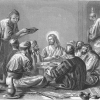
The time came when Jesus went into one the rulers of the Pharisees home to eat bread on the Sabbath day. They were watching him to see what he would do.
And a man with the dropsy came and stood before Jesus.
Jesus knew what the Pharisees were thinking, and said:
Is it lawful to heal on the Sabbath, or not?
The Pharisees didn’t say a word.
Jesus then healed the man.
Then he said to the Pharisees:
Which one of you whose ox or donkey fell into a well on the Sabbath day would not immediately pull him out?
They couldn’t answer him.
When Jesus saw how the Pharisees honored themselves by taking the chief seats. He told them a parable.
Jesus said:
When you are invited to a marriage feast, don’t sit in the place of honor, or someone who is more important than you will come in and you will be asked to move to one of the lesser seats.
But instead, find the lowest seat you can and take it so that when the host comes he will invite you to take a better seat next to the host, and you will receive honor from everyone there.
Everyone who exalts himself will be humbled, and he who humbles himself will be exalted.
And then he said to the Pharisee who had invited him to eat:
When you make a dinner or a supper, don’t call your friends, or your brothers, or your relatives or your rich neighbors. They can all pay you back with the same hospitality.
When you make a feast, invite the poor, the injured, the lame and the blind. You will be blessed because they do not have any way to repay you. You will receive a reward in the resurrection of the just.
One of the guests at the meal with Jesus, after hearing what Jesus said, exclaimed:
Blessed is the person that eats bread in the kingdom of God.
But Jesus answered him:
A man made a great supper, and he invited many to come. He sent his servants out to ask his friends to come because the feast was just about ready.
But the friends began to make excuses as to why they could not come.
One invited guest said:
I have just purchased a field and I need to go see it, please excuse me from coming.
Another invited guest said:
I have just purchased five yoke of oxen, I need to go and try them out, please excuse me.
And another said:
I have just gotten married and I cannot come.
When the servant came to his master and told him how his invited guests had replied, the man became very angry. He said to his servant:
Go quickly into the streets and lanes of the city and bring in the poor, the maimed and the blind.
After that had been done there was still room at the feast. So the servant was sent to find guests in the highways and hedges, until the man’s house was full.
The Master of the feast said:
None of those men who were first invited will ever taste my feast.
Contents - Prev - thestoryofjesus101 (jesuspub3) - Next
BIBLE - WEB,
KJV,
ASV(Quiz),
NIV,
개역한글KHRV(
120일1독,
1년1독,
권별,
성경통독
)
STUDY - 구절(WESLEY),
단락(MATTHEW),
테마별,
Dictionary - Chapter,
OT구약,
NT신약,
읽기(Wayne),
소요리,
대요리 문답,
신앙고백WCF
성경연대표
1.창조
2.족장
3.출애굽
4.광야
5.정복
6.사사
7.통일왕국
8.분열왕국
9.포로
10.포로귀환
11.중간
12.예수
13.초대교회
14.세계선교

1 And it came to pass, when he went into the house of one of the rulers of the Pharisees on a sabbath to eat bread, that they were watching him. (The Pharisees were an unorganized party, hence their rulers were such not by office, but by influence. Those who were members of the Sanhedrin, or who were distinguished among the rabbis, might fitly be spoken of as rulers among them. The context favors the idea that Jesus was invited for the purpose of being watched--a carrying out of the Pharisaic purpose declared at Luke 11: 53, 54. Bountiful feasts on the Sabbath day were common among the Jews; the food, however, was cooked the previous day in obedience to the precept at Exodus 16: 23).
2 And behold, there was before him a certain man that had the dropsy. (The phrase "let him go" of Luke 14: 4 shows that the man was not a guest, but rather one who seems to have taken advantage of the freedom of an Oriental house to stand among the lookers-on. He may have been there purely from his own choice, but the evil intention with which Jesus was invited makes it highly probable that the man's presence was no accident, but part of a deep-laid plot to entrap Jesus.)
3 And Jesus answering (replying to their unspoken thoughts, in which they were assuming that he would heal the sick man) spake unto the lawyers and Pharisees, saying, Is it lawful to heal on the sabbath, or not?
4 And they held their peace. (They evidently expected Jesus to act on the impulse, and were confused by his calm, deliberate question. If they declared it lawful, they defeated their plot, and if they said otherwise, they involved themselves in an argument with him in which, as experience taught them, they would be humiliated before the people. Hence, they kept silence, but their silence only justified him, since it was the duty of every lawyer to pronounce this act unlawful if it had been so.) And he took him, and healed him, and let him go.
5 And he said unto them, Which of you shall have an ass or an ox fallen into a well, and will not straightway draw him up on a sabbath day?
6 And they could not answer again unto these things. (Here Jesus again asserts that the Sabbath law did not forbid acts of mercy. See pp. 212, 213, 215. Though silenced, the Pharisees relented not, either as to their bigotry or their hatred.)
7 And he spoke a parable unto those that were bidden, when he marked how they chose out the chief seats (The triclinia, or Grecian table, then in use had three sections which were placed together so as to form a flat-bottomed letter U. The space enclosed by the table was not occupied. It was left vacant that the servants might enter it and attend to the wants of the guests who reclined around the outer margin of the table. The central seat of each of these three sections were deemed a place of honor. This struggle for precedence was a small ambition, but many of the ambitions of our day are equally small); saying unto them,
8 When thou art bidden of any man to a marriage feast (Jesus mentions another kind of feast than the one in progress, that he may not be needlessly personal), sit not down in the chief seat; lest haply a more honorable man (Philippians 2: 3) than thou be bidden of him,
9 and he that bade thee and him shall come and say to thee, Give this man place; and then thou shalt begin with shame to take the lowest place. (Because when ousted from the top he would find every place full except the bottom.)
10 But when thou art bidden, go and sit down in the lowest place; that when he that hath bidden thee cometh, he may say to thee, Friend, go up higher: then shalt thou have glory in the presence of all that sit at meat with thee. (The words here used by our Lord teach how to avoid earthly shame and to obtain worldly honor. But they form a parable which is intended to teach the great spiritual truth that true humility leads to exaltation.)
11 For everyone that exalteth himself shall be humbled; and he that humbleth himself shall be exalted. (This is one of our Lord's favorite maxims (Luke 18: 14; Matthew 23: 12). Both man and God look upon humiliation as the just punishment of pride; but it is a pleasure to every right-minded spirit to give joy to the humble by showing him respect and honor.)
12 And he said to him also that had bidden him, When thou makest a dinner or a supper, call not thy friends, nor thy brethren, nor thy kinsmen, nor rich neighbors; lest haply they also bid thee again, and a recompense be made thee.
13 But when thou makest a feast, bid the poor, the maimed, the lame, the blind:
14 and thou shalt be blessed; for they have not wherewith to recompense thee: for thou shalt be recompensed in the resurrection of the just. (According to the Oriental mode of speech Jesus here emphatically commands one course of action by prohibiting a contrary course. But his prohibition is not to be construed strictly. He does not forbid the exercise of social hospitality, but discountenances that interested form of it which seeks a return. His teaching is positive rather than negative, and should constrain us to live more for charity and less for sociability. Some think that this verse teaches that there shall be two resurrections, but the contrast is not between two times, but rather between two parties or divisions of one resurrection. If one has part in the resurrection of the just, he may expect recompense for his most trivial act. But if he be resurrected among the unjust, he need expect no reward, even for the most meritorious deeds of his whole life.)
15 And when one of them that sat at meat with him heard these things, he said unto him, Blessed is he that shall eat bread in the kingdom of God. (The language of Christ implied that God himself would feast those who feasted the poor, and this implication accorded with the Jewish notion that the kingdom of God would be ushered in with a great festival. Inspired by this thought, and feeling confident that he should have been part of the festivities, this guest exclaimed upon the anticipated blessedness.)
16 But he said unto him, A certain man made a great supper; and he bade many:
17 And he sent forth his servant at supper time to say to them that were bidden, Come; for all things are now ready. (The custom of sending a second invitation at the supper hour is a very old one (Esther 5: 8; 6: 14), and is still observed.)
18 And they all with one consent began to make excuse. The first said unto him, I have bought a field, and I must needs go out and see it; I pray thee have me excused.
19 And another said, I have bought five yoke of oxen, and I go to prove them; I pray thee have me excused.
20 And another said, I have married a wife, and therefore I cannot come. (These three excuses show: 1. That the guests had made their engagements, either for business or pleasure, without the least regard for the hour of the banquet; 2. That they set little value upon either the friendship or the feast of the one who had invited them. Moreover, the excuses progress in disrespect, for the first excuse is on the ground of necessity, the second simply offers a reason, and the third is almost impudent in its bluntness. Viewing the excuses spiritually, we note that each one contains an element of newness--new field, new oxen, new wife. Thus the things of the earth seem new and sweet in comparison with the gospel invitation. Again, all the excuses are trifling, for the parable is intended to teach that men forego their rights to heaven for trifles. Again, the "sacred hate" of Luke 14: 25, 26 would have eliminated all these excuses. Possibly Paul had this parable in mind when he wrote 1 Corinthians 7: 29-33. The three excuses warn us not to be hindered by 1. the love of possessions; 2. the affairs of business; 3. Our social ties.)
21 And the servant came, and told his lord these things. Then the master of the house being angry said to his servant, Go out quickly into the streets and lanes of the city, and bring in hither the poor and maimed and blind and lame.
22 And the servant said, Lord, what thou didst command is done, and yet there is room.
23 And the lord said to the servant, Go out into the highways and hedges, and constrain them to come in, that my house may be filled.
24 For I say unto you, that none of those men that were bidden shall taste of my supper. (We have a preliminary or general invitation followed by three special invitations. We may regard the general invitation as given by Moses and the prophets in the ages before the feast was prepared. Then the first special one would be given by John the Baptist and Christ to the Jewish nation in the first stages of Christ's ministry. The second special invitation was given by Christ, the twelve and the seventy, and came more especially to the poor and outcast, the publicans and sinners, because the leading men of the nation spurned the invitation. The third invitation was begun by the apostles after the Lord's ascension and is still borne forward by those who have come after them and includes all nations. The three conditions of Jew, outcast and Gentiles are indicated by the three orders of guests: 1. The honorable citizens of the city; 2. Those who frequent the streets and lanes, but are still in and out of the city; 3. Those who live without the city and are found upon the highways and in the hedgepaths of the vineyards and gardens. The second and third classes are depicted as needing to be constrained. This would be so, because they would hold themselves unworthy of the invitation. But they were to be constrained by moral and not by physical means (Matthew 14: 22; 2 Corinthians 12: 11; Galatians 2: 14). Physical constraint would have been contrary to all custom, as well as impossible to one servant. Incidentally the parable shows the roominess of heaven and the largeness of divine hospitality, so that Bengel aptly observes, "Grace, no less than nature, abhors a vacuum.")
|
|||||||||||||||||||||||||||||||||||||||||||||||||||||||||||||||||||||||||||||||||||||||||||||||||||||||||||||||||||||||||||||||||||||||||||||||||||||||||||||||||||||||||||||||||||||||||||||||||||||||||||||||||||||||||||||||||||||||||||||||||||||||||||||||||||||||||||||||||||||||||||||||||||||||||||||||||||||||||||||||||||||||||||||||||||||||||||||||||||||||||||||||||||||||||||||||||||||||||||||||||||||||||||||||||||||||||||||||||||||||||||||||||||||||||||||













|
1창세기[Genesis] 2출애굽기[Exodus] 3레위기[Leviticus] 4민수기[Numbers] 5신명기[Deuteronomy] 6여호수아[Joshua] 7사사기[Judges] 8룻기[Ruth] 9사무엘상[1 Samuel] 10사무엘하[2 Samuel] 11열왕기상[1 Kings] 12열왕기하[2 Kings] 13역대상[1 Chronicles] 14역대하[2 Chronicles] 15에스라[Ezra] 16느헤미아[Nehemiah] 17에스더[Esther] 18욥기[Job] 19시편[Psalms] 20잠언[Proverbs] 21전도서[Ecclesiastes] 22아가[Song of Solomon] 23이사야[Isaiah] 24예레미야[Jeremiah] 5예레미아애가[Lamentations] 26에스겔[Ezekiel] 27다니엘[Daniel] 28호세아[Hosea] 29요엘[Joel] 30아모스[Amos] 31오바댜[Obadiah] 32요나[Jonah] 33미가[Micah] 34나훔[Nahum] 35하박국[Habakkuk] 36스바냐[Zephaniah] 37학개[Haggai] 38스가랴[Zechariah] 39말라기[Malachi] 40마태복음[Matthew] 41마가복음[Mark] 42누가복음[Luke] 43요한복음[John] 44사도행전[Acts] 45로마서[Romans] 46고린도전서[1 Corinthians] 47고린도후서[2 Corinthians] 48갈라디아서[Galatians] 49에베소서[Ephesians] 50빌립보서[Philippians] 51골로새서[Colossians] 52데살로니가전서[1 Thessalonian] 53데살로니가후서[2 Thessalonian] 54디모데전서[1 Timothy] 55디모데후서[2 Timothy] 56디도서[Titus] 57빌레몬서[Philemon] 58히브리서[Hebrews] 59야고보서[James] 60베드로전서[1 Peter] 61베드로후서[2 Peter] 62요한일서[1 John] 63요한이서[2 John] 64요한삼서[3 John] 65유다서[Jude] 66요한계시록[Revelation] |
