

- 오늘의 예배

- 오늘의 한글성경
- 오늘의 WEB성경
- English Bible Story
- 01.창조시대 EBS
- 02.족장시대 EBS
- 03.출애굽기 EBS
- 04.광야시대 EBS
- 05.정복시대 EBS
- 06.사사시대 EBS
- 07.통일왕국 EBS
- 08.분열왕국 EBS
- 09.포로시대 EBS
- 10.포로귀환 EBS
- 11.중간시대 EBS
- 12.예수시대 EBS
- 13.초대교회 EBS
-----Readed_count
-----Update
Mobile Bible, Mobile B-Story, Today's iWorship, 요리문답, Quiz추가&수정, Dictionary추가&수정




BIBLE - WEB,
KJV,
ASV(Quiz),
NIV,
개역한글KHRV(
120일1독,
1년1독,
권별,
성경통독
)
STUDY - 구절(WESLEY),
단락(MATTHEW),
테마별,
Dictionary - Chapter,
OT구약,
NT신약,
읽기(Wayne),
소요리,
대요리 문답,
신앙고백WCF
성경연대표
1.창조
2.족장
3.출애굽
4.광야
5.정복
6.사사
7.통일왕국
8.분열왕국
9.포로
10.포로귀환
11.중간
12.예수
13.초대교회
14.세계선교

MATTHEW 4: 18-22; MARK 1: 16-20; LUKE 5: 1-11.
Matthew 4: 18 And walking
Mark 1: 16 And passing along by the sea of Galilee (This lake is a pear-shaped body of water, about twelve and a half miles long and about seven miles across at its widest place. It is 682 feet below sea level; its waters are fresh, clear and abounding in fish, and it is surrounded by hills and mountains, which rise from 600 to 1,000 feet above it. Its greatest depth is about 165 feet), he (Jesus) saw two brethren, Simon who is called Peter, and Andrew his brother, {the brother of Simon} casting a net in {into} the sea (The New Testament speaks of three kinds of nets, viz.: the amphiblestron, which is only mentioned here; the sagene, mentioned only at Matthew 13: 47; and the dictua, which is mentioned in all other places. The dictua was a casting-net; the sagene, a seine or dragnet; and the amphiblestron was a drawnet, a circular bell-shaped affair, which was thrown upon the water, so that it spread out and caught, by sinking, whatever was below it); for they were fishers. (Though Simon and Andrew had been companions of Jesus on at least one journey, they did not as yet understand that his service would require all their time. The facts that Jesus now temporarily resided at Capernaum afforded them an opportunity to return to their old occupation, which they readily embraced. Fishing was then a prosperous trade on the lake of Galilee.)
17 And Jesus said { he saith} unto them, Come ye after me, and I will make you to become fishers of men. (It was an invitation to follow, that they might be instructed by hearing his teaching and beholding his work. Jesus called them from a lower to a similar but higher labor. He calls all honest tradesmen in this manner. He invites carpenters to build his temple, servants to serve the great King, physicians to heal immortal souls, merchants to invest in pearls of great price, etc. The fisherman found many points of resemblance between the old and new calling, such as, 1, daily hardships and dangers; 2, earnest desires for the objects sought; 3, skill and wisdom in the use of means, etc. Disciples are fishers, human souls are fish, the world is the sea, the gospel is the net, and eternal life is the shore whither the catch is drawn.)
Matthew 4: 21 And going on from thencea little further, he saw two other brethren, James the son of Zebedee, and John his brother, who also were in the boat with Zebedee their father, mending their { the} nets. (They also, like Peter and Andrew, were at work when Jesus found them. God calls the busy to his business. For instances where God had called the busy, see cases of Moses (Exodus 3: 1, 2), Gideon (Judges 6: 11), Saul (1 Samuel 10: 1-3), David (1 Samuel 16: 11-15), Elisha (1 Kings 19: 19-21), Matthew (Matthew 9: 9), Saul (Acts 9: 1-6). Moreover most of these were called from lowly work, for such is God's method (1 Corinthians 1: 26-29). We should note two reasons why God chose the lowly and unlearned: 1, their minds being free from prejudice were more ready to entertain new truth; 2, the strength of the gospel was made more apparent by the weakness of its ministers (1 Corinthians 2: 3-5; 2 Corinthians 4: 7; Zechariah 4: 6). Of these two brothers, James was the first apostolic martyr and John the last survivor of the twelve. James was beheaded about a.d. 44 (Acts 12: 1, 2); and John, after upwards of seventy years of Christian service, died at Ephesus about A.D. 100.)
Mark 1: 20 And straightway he called them (From Matthew and Mark we would suppose that Jesus was alone when he called the two sets of brothers, and that with them he immediately left the lake. But we learn from Luke that he taught and worked a miracle before leaving the lake):
Luke 5: 1 Now it came to pass, while the multitude pressed upon him and heard the word of God, that he was standing by the lake of Gennesaret (This body of water bore many names. It was anciently called Chinnereth (Numbers 34: 11), or Chinneroth (Judges 12: 3), from a fortified town (Joshua 19: 35 ) and district (1 Kings 15: 20) in Naphtali bearing that name. It is here called Gennesaret, from a plain of that name upon its northwestern shore (which may be a corruption of the old name Chinnereth.) It received its name, Galilee, from the district to which it belongs, and in later times it bore the name Tiberias (John 6: 1), from the city of that name on its western shore);
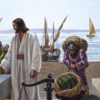
2 and he saw two boats standing by the lake: but the fishermen had gone out of them, and were washing their nets. (We may conceive of the fishermen, in answer to Jesus' call, drawing their boats together to the point where he stood upon the shore. Then, as Jesus stood teaching, they occupied themselves in the shallow water behind by washing their nets while they listened to him.)
3 And he entered into one of the boats, which was Simon's, and asked him to put out a little from the land. (He did this that he might avoid the press, and that the people might be better able both to see and to hear.) And he sat down (the usual attitude or posture of a teacher) and taught the multitudes out of the boat.
4 And when he had left speaking, he said unto Simon, Put out into the deep, and let down your nets for a draught. ("Put out" is in the singular, being addressed to Simon alone; "let down" is plural, being addressed generally to those in the boat.)
5 And Simon answered and said, Master, we have toiled all the night, and took nothing: but at thy word I will let down the nets. ("Master" is a broader word than "Rabbi"; it indicates a superior, but does not confine his superiority to matters of instruction. The words of Peter show a willingness to oblige or honor Jesus, but are devoid of hope as to the thing proposed. Night was the time for fishing (John 21: 3); and the proper place to cast the net was near the shore; but if Jesus wished to fish by daylight in the middle of the lake, Simon was not too weary to humor the wish.)
6 And when they had done this, they inclosed a great multitude of fishes; and their nets were breaking (that is, the nets began to snap when they tried to lift them out of the water) ;
7 and they beckoned unto their partners in the other boat, that they should come and help them. (This indicates that they were well out into the lake, where it was easier to beckon than to shout explanations. Some think the marvel wrought by Jesus made them speechless, but they were so engrossed in the magnitude and value of the catch that the full glory of the miracle had not yet come upon them.) And they came, and filled both the boats, so that they began to sink. (They probably ran a second net under the one which enclosed the fishes, and by thus doubling the strength of the net were able to draw the fish up between the boats. A great load thus suddenly dumped in the side of a boat will cause it to list, dip water and threaten to sink. Such appears to have been the case here until the loads were so distributed as to right the ships.)
8 But Simon Peter, when he saw it, fell down at Jesus' knees, saying, Depart from me; for I am a sinful man, O Lord.
9 For he was amazed, and all that were with him, at the draught of the fishes which they had taken (This miracle came home to the soul of Peter because it was wrought in his own boat, with his own nets, and concerned his own business. Religion is only powerful as it becomes personal. Peter's request shows how deeply the miracle impressed him. It gave him that sense of the divine presence which never fails to overwhelm the hearts of men. No man can behold God in his glory and live (Exodus 33: 20-23; 20: 18, 19); and though there have been exceptions where men have seen God or his representatives and lived (Exodus 24: 9-11; Judges 6: 21-23; 13: 22, 23; Isaiah 6: 1-5; Daniel 10: 16-19; Genesis 32: 30); yet no man, not even the purest, has ever stood in the presence of God or his ministers without feeling such a sense of weakness and sinfulness as to almost extinguish life--Revelation 1: 17; Job 42: 5, 6) ;
10 and so were also James and John, sons of Zebedee, who were partners with Simon. And Jesus said unto Simon, Fear not; from henceforth thou shalt catch men. (Jesus here shows the purpose for which this miracle had been wrought. It was a prophetic type or picture which foreshadowed the triumphs of the day of Pentecost and other seasons when the apostles had great ingatherings of souls through the preaching of the gospel.)
11 And when they had brought their boats to land, they straightway left all (that is to say, Peter and Andrew),left the nets (but James and John), left the boat and their father, Zebedee in the boat with the hired servants, and went after him. {followed him} (The four partners, boats, different kinds of nets, hired servants, etc., and the fact that Salome, the wife of Zebedee, was one of those who ministered to Christ out of her substance (Matthew 27: 55, 56; Luke 8: 3), all indicate a business of respectable proportions: a fact which suggests that the church of Christ would catch more souls if all its parts were in partnership. Evidently when the four men left the boats and nets Zebedee took charge of them. While the four rightly recognized that the divine call was superior to their earthly obligations, there is nothing which leads us to imply that their sudden departure discomfited Zebedee. The call of Christ here marks a change in their relationship to him. Hitherto discipleship had not materially interfered with business, but this present call separated them from their occupation, and prepared them for the call to be apostles which came later, and which required them to be his constant companions--Mark 3: 14.)
|
|||||||||||||||||||||||||||||||||||||||||||||||||||||||||||||||||||||||||||||||||||||||||||||||||||||||||||||||||||||||||||||||||||||||||||||||||||||||||||||||||||||||||||||||||||||||||||||||||||||||||||||||||||||||||||||||||||||||||||||||||||||||||||||||||||||||||||||||||||||||||||||||||||||||||||||||||||||||||||||||||||||||||||||||||||||||||||||||||||||||||||||||||||||||||||||||||||||||||||||||||||||||||||||||||||||||||||||||||||||||||||||||||||||||||||||






|
1창세기[Genesis] 2출애굽기[Exodus] 3레위기[Leviticus] 4민수기[Numbers] 5신명기[Deuteronomy] 6여호수아[Joshua] 7사사기[Judges] 8룻기[Ruth] 9사무엘상[1 Samuel] 10사무엘하[2 Samuel] 11열왕기상[1 Kings] 12열왕기하[2 Kings] 13역대상[1 Chronicles] 14역대하[2 Chronicles] 15에스라[Ezra] 16느헤미아[Nehemiah] 17에스더[Esther] 18욥기[Job] 19시편[Psalms] 20잠언[Proverbs] 21전도서[Ecclesiastes] 22아가[Song of Solomon] 23이사야[Isaiah] 24예레미야[Jeremiah] 5예레미아애가[Lamentations] 26에스겔[Ezekiel] 27다니엘[Daniel] 28호세아[Hosea] 29요엘[Joel] 30아모스[Amos] 31오바댜[Obadiah] 32요나[Jonah] 33미가[Micah] 34나훔[Nahum] 35하박국[Habakkuk] 36스바냐[Zephaniah] 37학개[Haggai] 38스가랴[Zechariah] 39말라기[Malachi] 40마태복음[Matthew] 41마가복음[Mark] 42누가복음[Luke] 43요한복음[John] 44사도행전[Acts] 45로마서[Romans] 46고린도전서[1 Corinthians] 47고린도후서[2 Corinthians] 48갈라디아서[Galatians] 49에베소서[Ephesians] 50빌립보서[Philippians] 51골로새서[Colossians] 52데살로니가전서[1 Thessalonian] 53데살로니가후서[2 Thessalonian] 54디모데전서[1 Timothy] 55디모데후서[2 Timothy] 56디도서[Titus] 57빌레몬서[Philemon] 58히브리서[Hebrews] 59야고보서[James] 60베드로전서[1 Peter] 61베드로후서[2 Peter] 62요한일서[1 John] 63요한이서[2 John] 64요한삼서[3 John] 65유다서[Jude] 66요한계시록[Revelation] |
